

Laminate vs Hybrid for Melbourne Kitchens: Which Handles Spills?
The kitchen is the one room where the flooring question gets serious, because it is the one room that gets wet on a normal Tuesday. If you are choosing between laminate and hybrid for a Melbourne kitchen, the honest short answer is: hybrid is safer around water, but a good water-resistant laminate can still work if you know its limits. After fitting both across kitchens in Melbourne's north and west from our Thomastown showroom, here is the balanced, spill-focused comparison we give customers in person.
The core difference: water-resistant vs waterproof#
This distinction decides everything else, so start here.
- Laminate is a high-density fibreboard (HDF) core with a printed timber-look layer and a tough wear layer on top. That HDF core is essentially compressed wood. Standard laminate is not waterproof — if water gets into a joint and sits there, the core can swell. "Water-resistant" laminate is better sealed at the joins and can handle a wiped-up spill, but the core itself is still wood-based.
- Hybrid is built on a rigid SPC (stone plastic composite) core, which contains no wood to swell. Quality hybrid is 100% waterproof through the whole board, not just the surface. Water can sit on it and it will not damage the core.
So the real question for a kitchen is not "will it survive a splash" — both will — but "what happens when water gets left, or gets under the boards."
What happens with a spill you wipe up straight away#
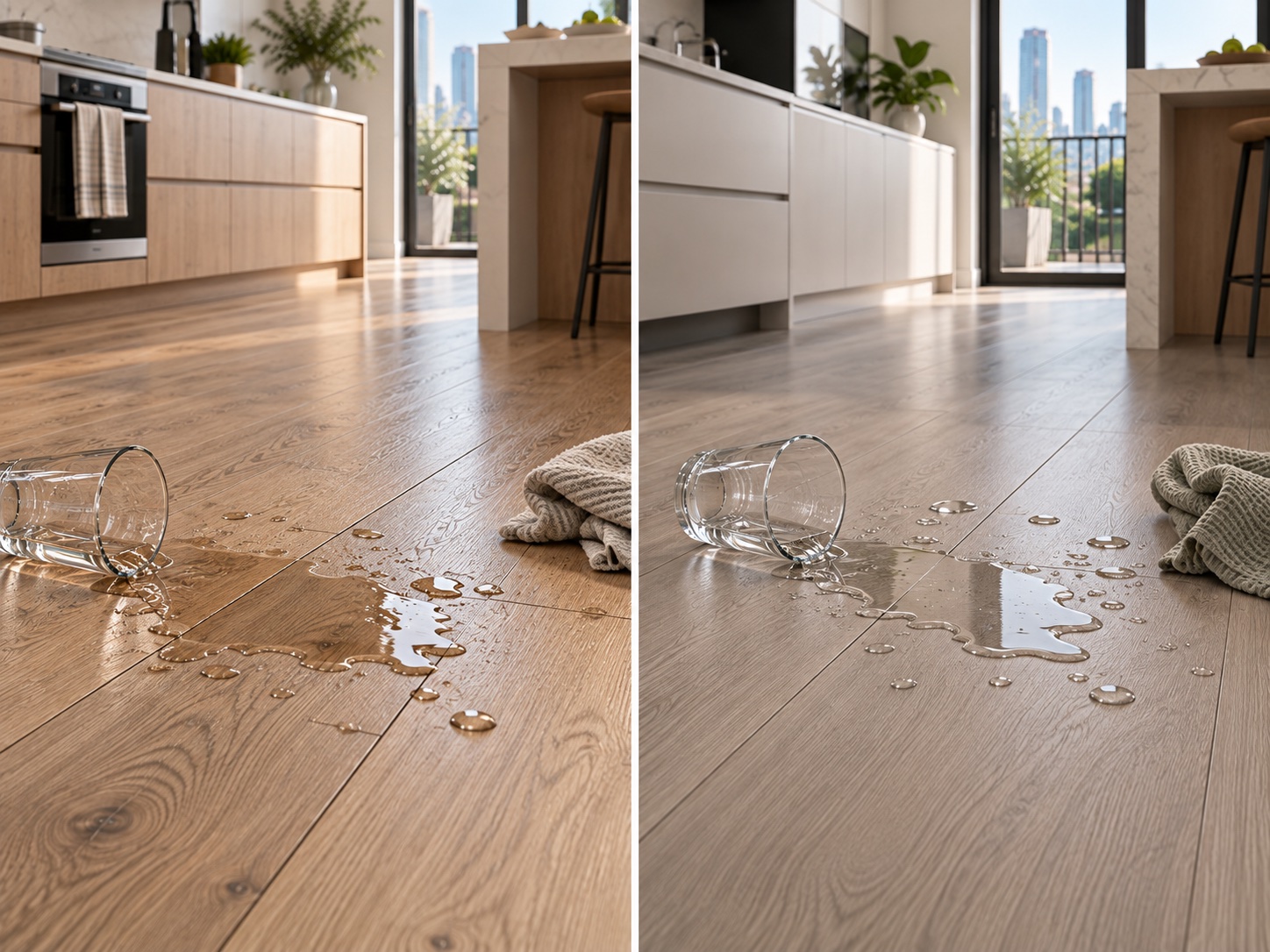
For everyday cooking life — a splash at the sink, a dropped ice cube, a bit of pasta water — there is no practical difference. A water-resistant laminate and a hybrid both shrug off a spill you wipe within a reasonable time. Both are far better than the swelling, warping timber laminate of ten years ago. If your kitchen life is tidy and quick to mop, a good water-resistant laminate will serve you well and look excellent doing it.
What happens with a spill that sits — or a leak you do not see#
This is where the two floors part ways, and it is the scenario that actually ruins kitchens in Melbourne homes.
Picture a dishwasher hose that fails while you are at work, or a fridge water line that weeps behind the cabinetry for a week. Water pools, then creeps under the boards and into the joints.
- On laminate, that standing water finds its way into the HDF core through the locking joints. The board edges swell, lift, and chip, and the damage is usually not reversible — the affected boards need replacing, and swelling can spread beyond the wet patch. Water-resistant laminate buys you more time, but it is not a licence to leave water sitting.
- On hybrid, the SPC core does not absorb water. The same leak wipes up and the floor keeps going. There is no core to swell, so a slow, hidden leak that would destroy a laminate kitchen is a non-event on hybrid.
For risk alone, hybrid clearly wins the kitchen. The question is whether that extra safety is worth the trade-offs.
Swelling risk lives at the board edges#
It helps to know exactly where laminate is vulnerable, because it is not the surface — it is the joints. The printed and wear layers on top are genuinely tough and shed water. The weak point is the exposed HDF at the edges where two boards click together. Water that reaches those edges is what causes swelling.
Good installation reduces this risk a lot: tight, quality locking joints, a proper expansion gap sealed with the right silicone at cabinet kicks and wet zones, and beading or trims that keep water from running down the edges. A well-laid water-resistant laminate kitchen can last for years without trouble. But it is a floor with a weak point you are managing, whereas hybrid simply does not have that weak point.
Cost: laminate usually wins on price#
Money matters, so let us be straight. Laminate is generally cheaper than hybrid, both for the boards and often for a simpler install. For a budget-conscious kitchen renovation in Reservoir, Epping or Werribee, a quality water-resistant laminate can deliver a beautiful timber look for less. Hybrid costs more, but that premium is buying you the waterproof insurance policy against the leak you cannot predict. Think of the difference as the price of not gambling your kitchen floor on your dishwasher's plumbing.
Looks and feel: honestly, very close#
Modern printing has narrowed the gap here. Both laminate and hybrid come in convincing oak, spotted-gum and blackbutt looks, in wide planks, matte and low-sheen finishes, and with realistic embossed grain. A few real differences:
- Hybrid's rigid SPC core feels a touch harder and colder underfoot; many quality hybrids include a pre-attached acoustic underlay that softens this and cuts noise.
- Laminate can feel slightly warmer and often comes in a wider spread of decors at the affordable end.
- Both suit the open-plan kitchen-living layouts common in newer Melbourne homes and townhouses.
If you want to compare the ranges side by side, browse our laminate flooring range and our hybrid flooring options — the boards sit close on looks, so the decision usually comes down to water risk and budget, not appearance.
Melbourne climate and the subfloor underneath#
Melbourne's big temperature swings — a 40°C-plus summer day into a cold snap — move any floating floor. Hybrid's rigid SPC core expands and contracts less than a laminate's HDF core, which means fewer gaps and a tighter floor over time, especially on a sun-exposed concrete slab in a western-suburbs build. On a suspended timber subfloor in an older Footscray or Essendon home, both need proper acclimatisation and the correct expansion gap. Either way, the subfloor must be dry and level before we lay — a good floor over a damp slab fails regardless of type.
Our honest recommendation for an open-plan kitchen and living area#
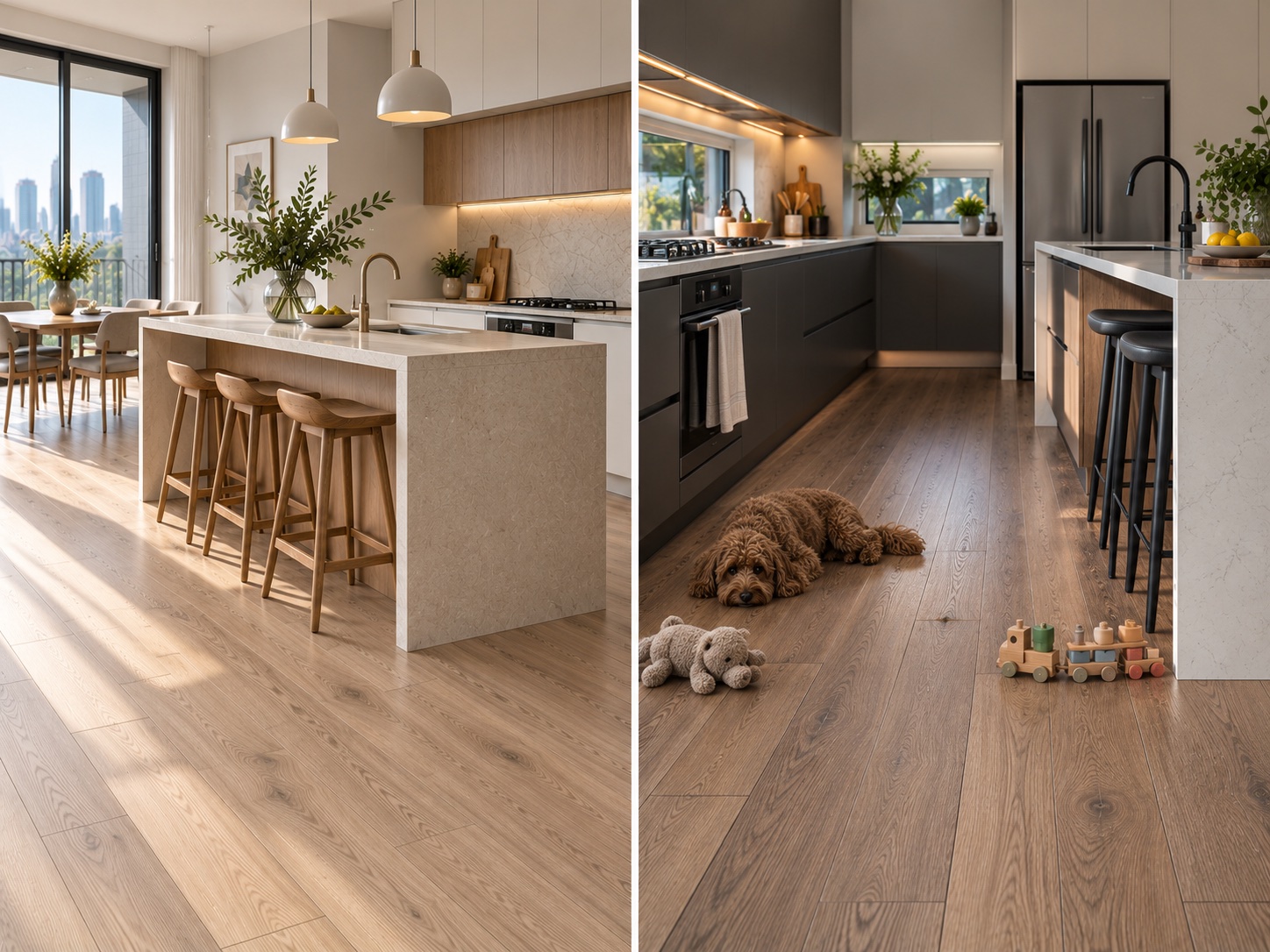
For most Melbourne kitchens — and especially the open-plan kitchen-meals-living layouts that flow into one continuous floor — we lean towards hybrid. Here is the reasoning:
- The waterproof core removes the one failure mode that actually destroys kitchen floors: the unseen leak.
- Running one continuous floor through kitchen, dining and living looks seamless, and you do not want the wettest room in that run to be the vulnerable one.
- The lifetime cost is lower once you factor in the leak you avoid.
Choose water-resistant laminate instead when the budget is tight, the kitchen is a defined, closed space rather than open-plan, and you are confident about tidy habits and good plumbing. It is a genuinely good floor — just one with a known weak point at the joints that you manage with care and correct installation.
There is no wrong answer here, only the right trade-off for your home, your budget, and how much you want to think about your floor again.
Related guides#
For more Melbourne flooring guidance, read Hybrid Flooring vs Laminate and What Is the Difference Between Hybrid and Laminate Flooring. Ready to plan your floor? Book a free measure and quote.
Frequently Asked Questions#
Is laminate okay in a kitchen at all?#
Yes — a quality water-resistant laminate is fine for a kitchen that gets wiped up promptly and is installed with sealed expansion joints at wet zones. The risk is standing water and hidden leaks reaching the board edges. If that worry keeps you up at night, hybrid removes it.
What actually happens to laminate in a dishwasher leak?#
Water reaches the exposed HDF core through the locking joints and the board edges swell, lift and chip. Water-resistant laminate resists this longer, but a sustained leak usually means replacing the affected boards. Hybrid's SPC core does not absorb water, so the same leak wipes up with no lasting damage.
Is hybrid worth the extra cost over laminate for a kitchen?#
For most Melbourne kitchens, yes. The price premium buys a 100% waterproof core that protects you from the one event — an unseen leak — that ruins kitchen floors. Over the life of the floor, avoiding one water-damage replacement usually more than covers the difference.
Can I run the same floor through my kitchen and living room?#
Absolutely, and it looks superb in an open-plan layout. Because the kitchen is the wet point in that continuous run, hybrid is the safer choice for a single floor flowing through kitchen, dining and living. Laminate works if the kitchen is a separate, closed room.
Get a straight answer for your kitchen from Mr Floor#
The right kitchen floor depends on your budget, your layout, and how much water risk you want to carry. Bring your plans to our Thomastown showroom at 216 Settlement Rd and feel both laminate and hybrid underfoot, or book a free measure and quote and we will bring samples to your home across Melbourne's northern and western suburbs. Call (03) 9961 4792 and we will give you the honest recommendation for your kitchen — not just the pricier box.
Last updated: 21 May 2026
Flooring expert at Mr Floor Melbourne.